Cloud security is a shared responsibility
For all cloud deployment types, you own your data and identities. You are responsible for helping secure your data and identities, your on-premises resources, and the cloud components you control (which vary by service type).
Regardless of the deployment type, you always retain responsibility for the following items:
- Data
- Endpoints
- Accounts
- Access management
A layered approach to security
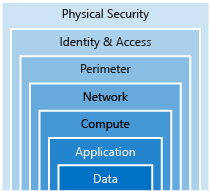
A great place to start when examining the security of your Azure-based solutions is Azure Security Center. Security Center is a monitoring service that provides threat protection across all of your services both in Azure, and on-premises. Security Center can:
Identity and access
Authentication and authorization
Two fundamental concepts that need to be understood when talking about identity and access control are authentication and authorization. They underpin everything else that happens and occur sequentially in any identity and access process:
Authentication is the process of establishing the identity of a person or service looking to access a resource. It involves the act of challenging a party for legitimate credentials, and provides the basis for creating a security principal for identity and access control use. It establishes if they are who they say they are.
Authorization is the process of establishing what level of access an authenticated person or service has. It specifies what data they're allowed to access and what they can do with it.
Azure provides services to manage both authentication and authorization through Azure Active Directory (Azure AD).
Single sign-on
Role-based access control
Encryption
Both symmetric and asymmetric encryption play a role in properly securing your data. Encryption is typically approached in two ways:
- Encryption at rest
- Encryption in transit
Microsoft Azure Information Protection (sometimes referred to as AIP) is a cloud-based solution that helps organizations classify and optionally protect documents and emails by applying labels.
Azure Advanced Threat Protection (Azure ATP) is a cloud-based security solution that identifies, detects, and helps you investigate advanced threats, compromised identities, and malicious insider actions directed at your organization.
Azure ATP is capable of detecting known malicious attacks and techniques, security issues, and risks against your network.
The Microsoft Security Development Lifecycle (SDL) introduces security and privacy considerations throughout all phases of the development process. It helps developers build highly secure software, address security compliance requirements, and reduce development costs. The guidance, best practices, tools, and processes in the SDL are practices used internally at Microsoft to build more secure products and services.
Defense in depth is the overriding theme - think about security as a multi-layer, multi-vector concern. Threats come from places we don't expect, and they can come with strength that will surprise us.


